
SAP SoD Analysis for Freelance Consultants: Why We Built a Freelance Edition
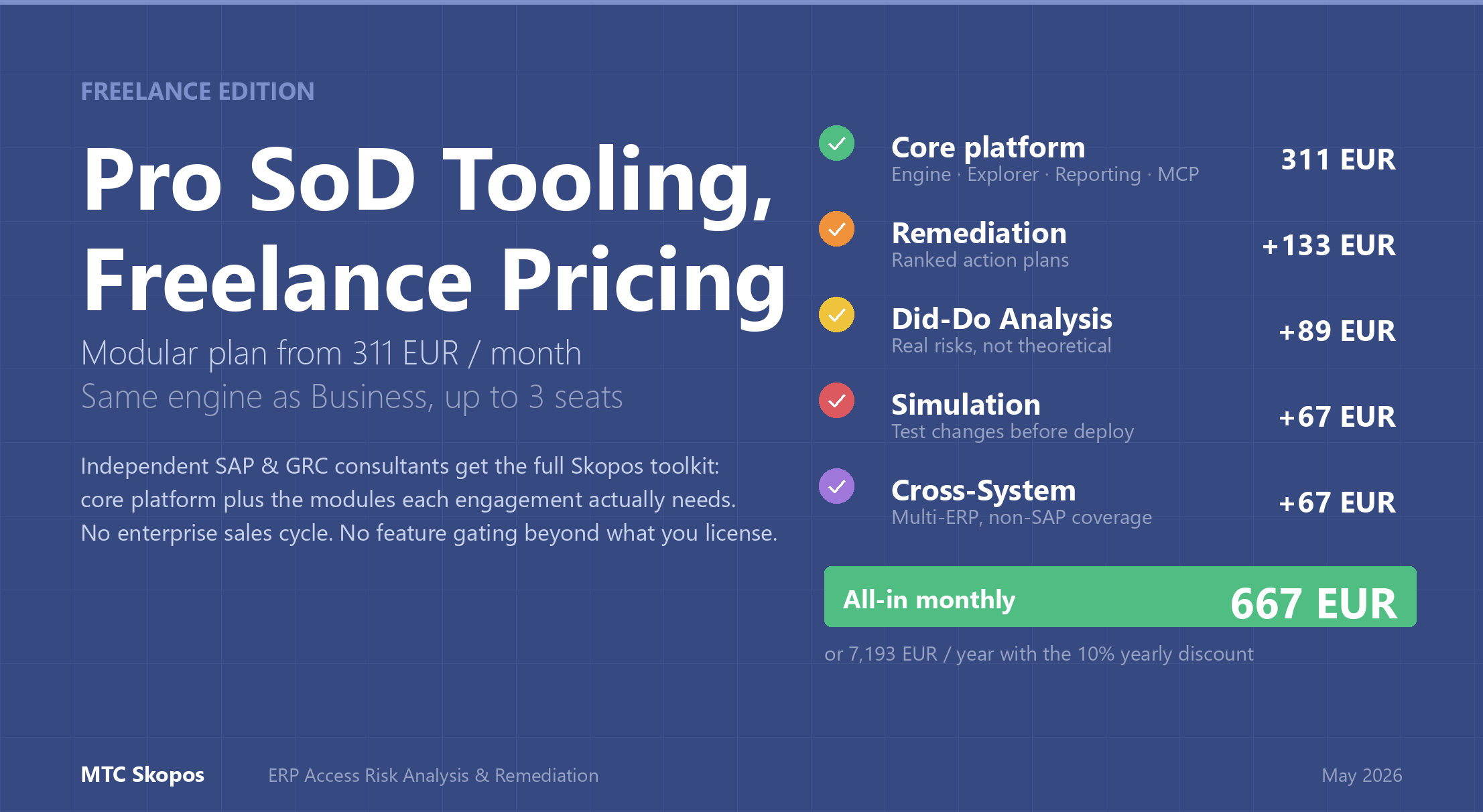
MTC Skopos Freelance edition is a modular licence of the same software Business clients use, designed for independent SAP and GRC consultants. Core platform plus à-la-carte modules. Up to 3 seats, no enterprise sales cycle, no feature gating beyond what you choose to license. Contact us for terms.
If you are a freelance SAP or GRC consultant, you already know the problem. You walk into a client engagement, the scope is SoD analysis or access risk remediation, and the client expects a professional tool to back the analysis. SAP GRC Access Control is licensed to the client, not to you. Pathlock the same. Most boutique competitors quote five-figure annual contracts and need a procurement cycle. So you fall back to spreadsheets, custom scripts, or hours of manual queries against AGR_* tables.
That gap, between what freelancers deliver and what they have access to, is what the Freelance edition is built to close.
What independent consultants have been working with
Most freelance SAP/GRC engagements involve some flavour of access risk: an audit finding, a role redesign, a pre-GRC cleanup, an over-privileged-user review, a SoD ruleset build. The work itself is genuinely consultative. The tooling story has not kept up.
The historic options:
- The client's own GRC system. Sometimes this works, often it does not: GRC may be in implementation, not yet rolled out across all systems, or restricted to internal staff. You either wait for access or work around it.
- Spreadsheets and SQL queries against SAP tables. Free, infinitely flexible, completely manual. You spend half the engagement building the analysis instead of producing recommendations.
- Enterprise tools at enterprise prices. Procurement, contracts, multi-year commitments. The economics do not work for a 5 to 20-day engagement.
- Free or freemium SoD checkers. Usually transaction-level only, often false-positive heavy, no remediation, no simulation. Fine for a sniff test, not for a deliverable that survives audit review.
Freelancers are left choosing between professional analysis with no tooling, or fast tooling with no rigour.
What the Freelance edition is
Same engine as the Business edition. Same multi-system support, same authorization-object-level analysis, same MCP server for AI workflows. Modular structure: license the core platform and add only the modules a given engagement needs.
The core platform includes the risk analysis engine, multi-system support, the User and Role Explorer, executive reporting, technical documentation, and the MCP server for AI integration.
Four optional add-on modules can be enabled independently:
- Remediation Report — algorithmic remediation recommendations with the supporting role-redesign analysis.
- Did-Do Analysis — combine authorization analysis with execution evidence (CDHDR / change documents) to show what users actually did, not just what they could do.
- Simulation — model the risk impact of role or authorization changes before applying them.
- Cross-System — risk analysis spanning multiple ERPs or SAP landscapes in a single ruleset.
Up to 3 seats, so a small boutique practice or a freelancer with an associate can share the licence. Beyond that, the Business plan removes the cap.
Why we built it
Two reasons, neither of them an accident.
Independent consultants do good work and deserve professional tools. The SAP SoD/GRC market relies heavily on independents and small boutiques to deliver actual remediation work, not just diagnosis. Most enterprise vendors treat that population as too small to license. We disagree.
Module-level licensing matches how engagements actually work. A simulation-heavy engagement does not need cross-system. A multi-ERP audit is the opposite. Locking everything behind one bundle forces freelancers to overpay on tools they will not use this quarter. The modular shape lets the licence scope track the engagement scope.
When the Freelance edition pays for itself
A few engagement shapes where the math is obvious.
- A single SAP SoD audit assist. Core platform plus the Remediation Report module. A typical SoD assist engagement is 5 to 10 days at consulting rates that start an order of magnitude above the tooling cost.
- A pre-GRC cleanup. Add Did-Do and Simulation. You deliver a defensible cleanup that an SAP GRC implementation can build on, and charge accordingly.
- An ongoing fractional GRC role for a mid-market client. The full all-in stack gives the client enterprise-grade SoD analysis without enterprise procurement. It is a service line you can package and resell.
- A multi-system risk landscape review. Add Cross-System. Most large landscapes have at least one non-SAP ERP or legacy SAP instance the GRC platform does not reach. This is exactly the gap that justifies the engagement.
In every one of these, the licensing cost is a fraction of a single billable day.
What does not change between Freelance and Business
A short list, because it matters:
- Same authorization-object-level analysis. No transaction-level fallback for the freelance tier. Same false-positive filtering across company codes, plants, profit centres, and any organizational scope.
- Same data residency model. Everything runs on your laptop. No cloud upload. No vendor-hosted data store. This matters when a client asks where their authorization extract is going, and you can answer "nowhere".
- Same AI integration. The MCP server is part of the core platform on both tiers. Plug Skopos into Claude, ChatGPT, or your own LLM and run analysis through natural language prompts during the engagement.
- Same ruleset format and quality. The maintained SoD ruleset that ships with Skopos is identical across tiers. Whatever you build or refine on a Freelance licence transfers directly when a client picks up the Business licence later.
The point of the Freelance edition is not a stripped-down tool. It is a tool licensed for the way independent consultants actually work.
How to start
The Freelance edition is sold directly. Contact us with the engagement scope and we will share the modules that fit and the commercial terms. The two-week trial covers the full toolkit, no credit card.
If you have a specific client engagement in mind and want to know whether the Freelance modules cover it, contact us with the scope. We will tell you which modules are sufficient for the work, including when the answer is "you do not need the Freelance plan, the trial covers this engagement".