
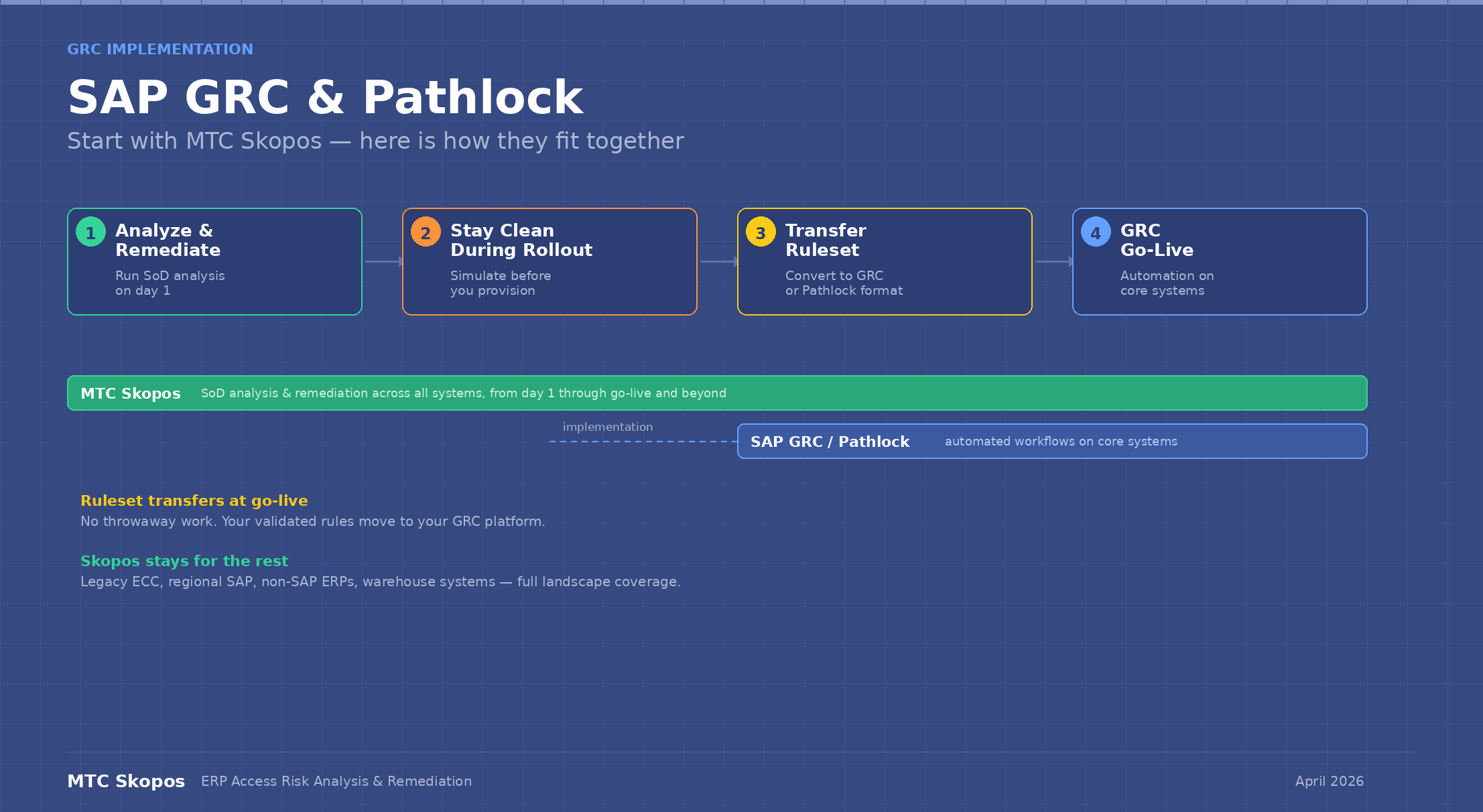
Planning SAP GRC or Pathlock? Start with MTC Skopos.
MTC Skopos before SAP GRC — If you are planning an SAP GRC or Pathlock implementation, run SoD analysis and remediation with MTC Skopos first. Clean your authorization landscape before automating it, keep it clean during rollout, and transfer your validated ruleset to your GRC platform at go-live. Nothing is throwaway.
If your organization has decided to implement SAP GRC Access Control or Pathlock, that makes sense. Integrated provisioning workflows, automated access requests, firefighter management across your core landscape. That is where you need to get to.
The question is what happens between now and go-live. Your segregation of duties risks are not on hold while your GRC platform gets configured.
SAP GRC implementations take months. Sometimes over a year. Pathlock rollouts are no different when you consider the full scope: configuring rulesets, designing workflows, integrating with your identity provider, onboarding business process owners, testing, fixing, testing again. It is a serious project, and it should be.
But your SoD risks are not waiting for your GRC platform to go live. Auditors still want a clean access matrix. New roles still get created. Provisioning decisions still need to be made with some visibility into the risks they create.
This is where MTC Skopos comes in.
SoD analysis and remediation before GRC go-live
A common mistake with GRC implementations: going live on top of a messy authorization landscape. Automating provisioning before cleaning up your roles means you are automating the distribution of risky access. Faster and at scale.
Skopos gives you the cleanup before the automation.
There is no implementation project. You install it, point it at your SAP data, and run a full SoD and critical access analysis on your current role design. Role-level, user-level, cross-system. You get a clear picture of your exposure and start remediating the same day, not the same quarter.
This is not a workaround for not having GRC yet. It is what every GRC implementation should start with. Organizations that arrive at SAP GRC go-live with a clean authorization landscape have faster rollouts and fewer emergency remediations.
Stay clean during rollout
Role remediation is not a one-time event. Between the day you clean up your landscape and the day your GRC platform goes live, people still need access, roles still get modified, and business does not stop.
Skopos keeps you covered during that period. Simulate role assignments before they happen. A manager requests a new role for a user? Run the simulation, check the SoD conflicts, decide. It is not the automated workflow you are building toward, but it gives you risk visibility on every provisioning decision until that workflow is ready.
Without this, months of remediation work can quietly unravel before your GRC suite even goes live.
Your SoD ruleset transfers directly
One concern we hear from organizations planning a GRC rollout: if we build a ruleset in Skopos now, do we lose that work when SAP GRC or Pathlock goes live?
No. The SoD ruleset you build in Skopos converts to SAP GRC or Pathlock format. The work carries over.
This matters more than it sounds. Ruleset quality is the hardest part of any GRC rollout, harder than the technology. Getting business process owners to agree on what constitutes a conflict, tuning out false positives, making sure your rules match how your organization actually operates. That takes iteration. Skopos lets you iterate quickly, with immediate feedback, without spinning up a full GRC environment. By the time your platform goes live, your ruleset has already been through real data and real discussions with process owners.
How MTC Skopos and SAP GRC complement each other
SAP GRC Access Control and Pathlock are workflow platforms. They automate provisioning, manage periodic reviews, handle firefighter sessions, and orchestrate access requests across your landscape. That is their value: connected, automated governance workflows.
MTC Skopos is a SoD risk analysis and remediation tool. It runs analysis across any system, produces remediation paths, and works without infrastructure. You install it, point it at data, and get answers. If you want to understand how it compares to other tools in the space, see our SoD tools comparison.
These are complementary. You do not choose between a diagnostic tool and a treatment plan. The analysis informs the automation. The automation sustains the cleanup.
What happens after GRC go-live
Here is what we see in practice.
SAP GRC or Pathlock goes live on the core landscape. The main S/4HANA system, maybe a few satellite instances. Provisioning is automated, workflows are in place, audit is satisfied.
Then the scope question comes up.
The regional SAP instance that was not in the GRC project plan. The legacy ECC system that is being decommissioned "next year," for the third year in a row. The non-SAP ERP that finance quietly relies on. The warehouse management system no one remembered to include.
Extending your GRC suite to every system in the landscape has a cost and a timeline. But the audit team still expects SoD coverage across the full environment, not just the systems connected to your workflow platform.
Skopos is already there. It already has the ruleset. It already works on those systems. So it stays. Not as a temporary fix, but as a permanent part of the GRC toolkit for the systems that do not justify a full platform connector.
How this looks in practice
If you are planning an SAP GRC or Pathlock implementation, this is the sequence that works:
-
Run Skopos against your current landscape. Get visibility into your SoD risks and start remediating. No project plan, no infrastructure. You can start with a quick risk assessment to see where you stand.
-
Build and validate your ruleset. Iterate on your risk definitions with business process owners. Get your ruleset right before loading it into your GRC platform.
-
Keep running Skopos during the implementation. Use it for day-to-day risk checks on provisioning decisions while your GRC workflows are being configured and tested.
-
Convert your SoD ruleset at go-live. Your target platform starts with a proven, refined rule set instead of a theoretical one.
-
Keep Skopos for the rest. After go-live, use it for every system your GRC suite does not cover.
Each step feeds into the next. The work you do in Skopos is not throwaway, it is the foundation your GRC platform builds on.
Contact us to see how Skopos fits into your GRC roadmap.