
Best SAP SoD Tools & Software: Segregation of Duties Comparison Guide (2026)
SoD tools are specialized software solutions that detect, analyze, and help resolve Segregation of Duties conflicts in enterprise systems like SAP. They examine user authorizations and role assignments to identify where a single person can perform incompatible actions, such as creating vendors and approving payments, reducing fraud risk and ensuring regulatory compliance.
Choosing the right SoD software can make the difference between spending months on manual access reviews and having a clear, actionable remediation path within days. The market for Segregation of Duties software and SoD tools has evolved significantly, with options ranging from heavyweight enterprise suites to specialized, high-performance analyzers.
This guide breaks down what to look for in segregation of duties tools, compares the leading SoD software solutions, and explains where MTC Skopos fits in the market landscape. Whether you're looking for segregation of duties software for SAP or a multi-ERP solution, this comparison will help you decide.
What is a SoD Tool?
A SoD tool (Segregation of Duties tool) is SoD software designed to detect, analyze, and help resolve access conflicts in enterprise systems. Also called segregation of duties software, these tools are essential for organizations running SAP and other ERPs. In the context of SAP SoD, these tools examine user authorizations, role assignments, and transaction access to identify situations where a single user can perform conflicting actions, such as creating a vendor and approving payments to that vendor.
Effective Segregation of Duties tooling goes beyond simple detection. Modern SoD tools should provide:
- Conflict Detection: Identify all users with access to conflicting transaction combinations
- Risk Scoring: Prioritize conflicts based on business impact and regulatory requirements
- SoD Remediation: Provide actionable guidance on how to resolve conflicts
- SoD Mitigation: When remediation isn't possible, enable monitoring controls through usage analysis
- Simulation: Test proposed changes before implementing them
The SoD Tool Market Landscape
The Segregation of Duties tools market can be divided into three categories:
1. Enterprise GRC Suites
Tools like SAP GRC Access Control and Pathlock offer comprehensive governance, risk, and compliance capabilities. They include SoD analysis as part of broader access governance, provisioning, and emergency access management features.
Best for: Organizations needing end-to-end access governance with workflow integration and provisioning capabilities.
What they do well: Automated access request workflows with embedded risk analysis, firefighter/emergency access management with session logging, periodic access review campaigns with audit trail, and native SAP provisioning that writes role assignments directly. If you need these workflow capabilities, a specialized SoD tool does not replace them.
Trade-offs: Higher implementation complexity (typically 3-12 months), significant infrastructure requirements, per-user pricing that scales with your SAP landscape.
2. Specialized Risk Analysis Tools
MTC Skopos, Access Informer, and IBS Schreiber (CheckAud) focus specifically on access risk analysis and SAP Segregation of Duties detection. These tools prioritize depth of analysis and speed over breadth of features.
Best for: Organizations that need fast, detailed SoD analysis without the overhead of a full GRC platform.
Trade-offs: Typically don't include provisioning or workflow capabilities (though they often integrate with provisioning tools).
3. Cloud-Native Solutions
Soterion and cloud deployments of Pathlock represent the newer generation of cloud-first SoD tooling. They offer SaaS deployment with regular updates and reduced infrastructure burden.
Best for: Organizations preferring subscription-based cloud services with vendor-managed infrastructure.
Trade-offs: Data leaves your infrastructure, which may conflict with privacy requirements or internal policies.
Key Features to Evaluate in SoD Tools
Analysis Speed and Scalability
How long does it take to analyze your entire SAP landscape? Some Segregation of Duties tools require hours to process large user populations. For organizations running regular audits or continuous monitoring, slow analysis creates operational bottlenecks.
MTC Skopos is engineered for speed, using a high-performance Rust engine that completes full SAP SoD analysis in minutes rather than hours, even for environments with tens of thousands of users.
SoD Remediation Capabilities
Detection is only half the battle. The real value of SoD tooling lies in helping you fix problems. Look for tools that provide:
- Specific recommendations: "Remove role X from user Y" rather than "consider reviewing user access"
- Impact analysis: Understanding what else breaks when you make a change
- Prioritization: Which conflicts matter most and should be addressed first
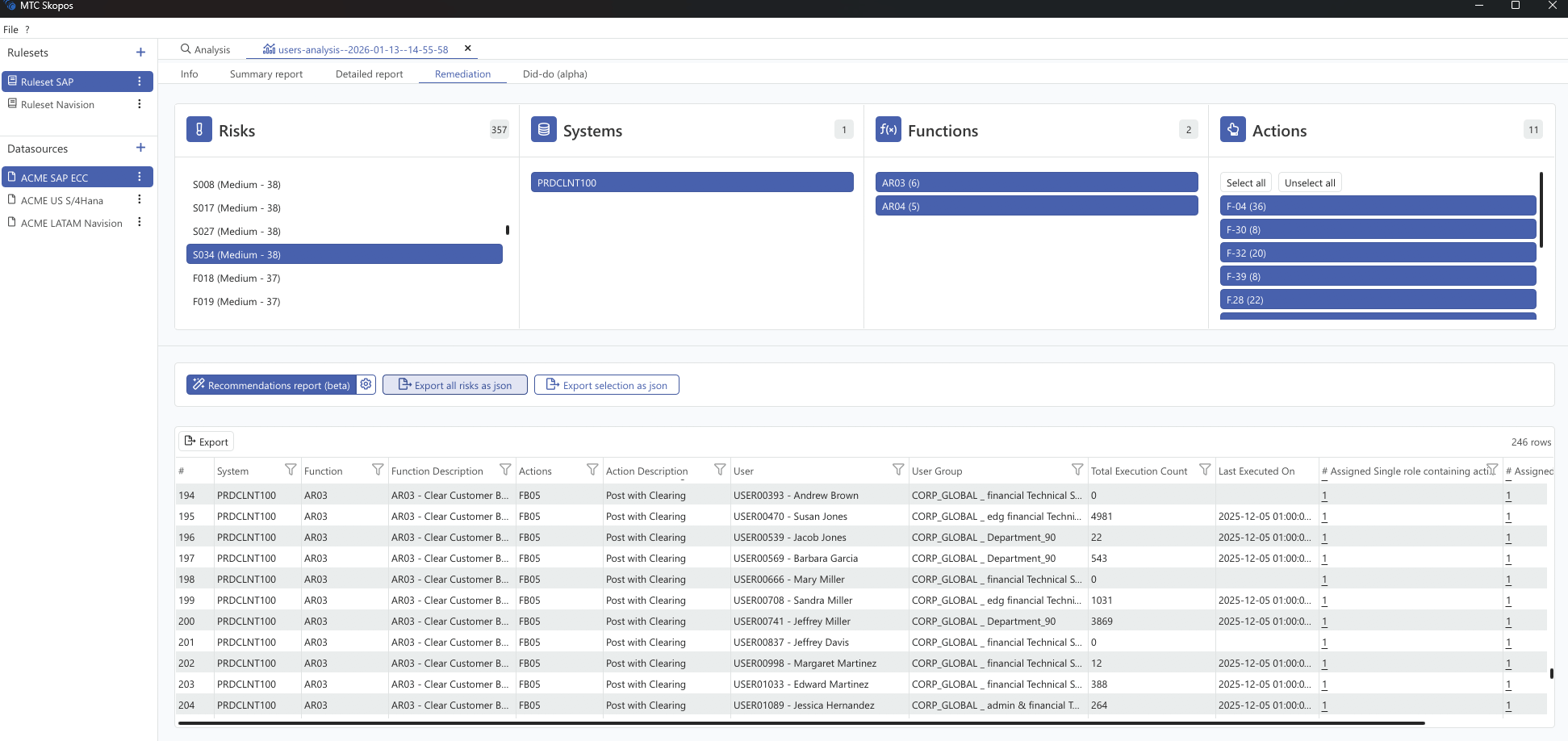
MTC Skopos includes an Advanced Remediation engine that generates concrete, actionable SoD remediation steps. The algorithm works through four phases, from simple role removal to role splitting, always trying the least disruptive fix first. Read more about how this works in our Advanced Remediation deep dive.
SoD Mitigation Through Did-Do Analysis
Not every conflict can be remediated. Business requirements sometimes mean users legitimately need conflicting access. In these cases, SoD mitigation through monitoring becomes essential.
Did-do analysis (also called execution analysis) tracks whether users with conflicting access actually execute both sides of the conflict. A user who can create a vendor AND approve payments presents a different risk than a user who actually does both.
MTC Skopos provides extensive did-do analysis capabilities, allowing you to:
- Identify which conflicts represent theoretical vs. actual risk
- Focus remediation efforts on conflicts with real transaction execution
- Document mitigating controls for auditors (monitoring users who haven't exercised conflicts)
- Track when previously inactive conflicts become active
This shifts SoD mitigation from periodic sampling to continuous, data-driven monitoring.
Multi-ERP and Cross-System Analysis
Modern enterprises rarely run just SAP. Effective Segregation of Duties software should analyze risks across your entire ERP landscape, not just within a single system.
MTC Skopos supports SAP Segregation of Duties analysis natively and extends to any ERP platform including Oracle, Microsoft Dynamics, Odoo, and custom systems. This enables identification of cross-system SoD conflicts that single-system tools miss entirely.
Deployment Model and Privacy
Where does your sensitive authorization data go? Cloud-based SoD tools require uploading user access information to third-party infrastructure. For many organizations, especially those in regulated industries, this creates unacceptable risk.
MTC Skopos runs entirely on-premise as a portable desktop application. Your SAP security data never leaves your infrastructure. There's no installation, no server infrastructure, no cloud dependencies, just download and run.
Comparing Leading SoD Tools
| Capability | MTC Skopos | SAP GRC | Pathlock | Access Informer | Soterion |
|---|---|---|---|---|---|
| Primary Focus | SoD Analysis | Full GRC Suite | Full GRC Suite | SoD Analysis | Risk Management |
| Analysis Speed | Minutes | Hours | Variable | Fast | Variable |
| SoD Remediation | Advanced algorithm | Basic | Limited | Basic | Get Clean Wizard |
| Did-Do Analysis | Extensive | Basic | Basic (AVM) | Basic | Extensive |
| Deployment | Desktop (portable) | On-premise/Cloud | Cloud | On-premise | Cloud |
| Multi-ERP | Any ERP | SAP focus | Multiple | SAP focus | SAP focus |
| Implementation | Same day | Weeks/months | Weeks | Days | Days |
| Pricing | Flat rate | Per-user | Per-user | Fixed | Variable |
For a complete feature-by-feature comparison, see our detailed GRC Tools Comparison page.
When to Choose Each Type of SoD Tool
Choose an Enterprise GRC Suite if:
- You need integrated provisioning and workflow capabilities
- You want emergency access management (firefighter IDs)
- Your organization has standardized on the vendor's platform
- You have the budget and resources for a significant implementation project
Choose a Specialized SAP SoD Tool like MTC Skopos if:
- You need fast, deep SAP SoD analysis without GRC overhead
- You're a consultant or auditor working across multiple client environments
- You want to be operational the same day you decide to evaluate
- Privacy requirements prevent sending data to cloud services
- You want transparent, predictable pricing that doesn't scale with user count
- You need advanced SoD remediation capabilities that go beyond simple reporting
Choose a Cloud-Native Solution if:
- You prefer SaaS deployment and vendor-managed infrastructure
- Your organization has embraced cloud-first IT strategies
- You're comfortable with authorization data in third-party systems
Using a specialized tool alongside a GRC suite
These categories are not mutually exclusive. Many organizations use a specialized SoD tool like MTC Skopos alongside SAP GRC Access Control — Skopos for fast analysis, ruleset development, and non-SAP systems, SAP GRC for automated provisioning and firefighter management on core SAP systems. The Skopos ruleset converts to SAP GRC format, so there is no duplicate work. For a detailed walkthrough of how this works, see Planning SAP GRC or Pathlock? Start With MTC Skopos.
SoD Resolution: From Detection to Clean State
The journey from "we have SoD conflicts" to "we've resolved our access risks" typically follows this path:
1. Initial Analysis
Run your Segregation of Duties tool against your SAP environment to establish a baseline. MTC Skopos can complete this initial analysis in minutes, providing a comprehensive view of all conflicts.
2. Risk Prioritization
Not all conflicts are equal. Prioritize based on:
- Business criticality of the conflicting transactions
- Regulatory requirements (SOX, etc.)
- Did-do analysis results (is the user actually executing both sides?)
3. SoD Remediation Planning
For conflicts that can be eliminated, develop a remediation plan. MTC Skopos's Advanced Remediation engine automates this, generating specific steps for each conflict:
- Remove unnecessary role assignments
- Split roles that combine conflicting access
- Reassign users to less risky role combinations
4. Simulation and Validation
Before implementing changes, simulate them. Will removing this role create new conflicts? Will it break business processes? Simulation capabilities prevent costly trial-and-error.
5. Implementation
Execute the remediation plan. For SAP environments, this means adjusting role assignments through SU01/PFCG or your provisioning tool.
6. SoD Mitigation for Remaining Risks
Some conflicts can't be eliminated, the business needs that access combination. For these, implement SoD mitigation controls:
- Document the business justification
- Establish monitoring through did-do analysis
- Set thresholds for acceptable activity
- Create alerts when users with mitigated conflicts execute both transactions
7. Continuous Monitoring
SoD isn't a one-time project. New users are created, roles are modified, and access accumulates. Regular analysis catches new conflicts before they become audit findings.
Best Segregation of Duties Software for SAP
We built MTC Skopos to address specific frustrations with existing SoD tooling and to be the best segregation of duties software for organizations running SAP:
Speed matters. Waiting hours for analysis results kills productivity and makes iterative remediation impractical. MTC Skopos completes full SAP SoD analysis in minutes.
Remediation guidance, not just reports. Most tools tell you what's wrong but leave you to figure out how to fix it. Our Advanced Remediation engine provides specific, actionable steps.
Did-do for real mitigation. When conflicts can't be eliminated, you need to monitor them. Extensive did-do analysis makes SoD mitigation practical and auditable.
No infrastructure burden. Download the application, export your SAP data, and start analyzing. No servers, no installation, no dependencies.
Transparent pricing. Flat-rate licensing means your costs don't explode as your SAP landscape grows. Starting at CHF 2,000/year with no per-user fees.
Privacy by design. Your authorization data stays on your infrastructure. For consultants and auditors, this means analyzing client systems without security concerns.
Getting Started with SoD Analysis
Whether you're evaluating Segregation of Duties tools for the first time or looking to replace an underperforming solution, the key is getting hands-on quickly.
MTC Skopos offers a 14-day trial that lets you analyze your actual SAP environment, not a demo system with artificial data. Export your SAP roles and users, run the analysis, and see your real SoD landscape within an hour of starting.
Try MTC Skopos Today
See your SAP SoD conflicts in minutes. Get specific remediation recommendations. No installation, no commitment.
Conclusion
The right SoD tool depends on your specific needs. Enterprise GRC suites offer breadth, cloud solutions offer convenience, and specialized tools like MTC Skopos offer depth and speed.
For organizations that need fast, thorough SAP Segregation of Duties analysis with practical SoD remediation and SoD mitigation capabilities, MTC Skopos delivers professional-grade analysis without the complexity and cost of enterprise platforms.
The difference between struggling with SoD and mastering it comes down to having the right tooling, software that finds conflicts quickly, explains how to fix them, and monitors what can't be eliminated.
Related Articles
- What is Segregation of Duties (SoD)? Meaning & Definition - Understand SoD fundamentals and common conflicts
- SoD Conflicts in SAP: How to Detect and Resolve Them - Practical guide to SAP SoD conflict resolution
- SAP SoD Matrix Template: Free Excel Download & Guide - Get started with your own SoD ruleset
- Accounts Payable SoD Matrix: AP Segregation of Duties Guide - AP-specific SoD conflict reference
- Advanced Remediation: AI-Powered SAP Access Risk Resolution - Deep dive into fixing SoD conflicts
- SAP FUE Optimization: Reduce License Costs - How authorization analysis also cuts SAP licensing costs
- How to Restrict G/L Account Access in SAP - Account-level authorization controls complementing SoD analysis
- Building an SoD Ruleset for S/4HANA - How to update your SoD ruleset for S/4HANA migration
- Planning SAP GRC or Pathlock? Start With MTC Skopos - How specialized SoD tools and GRC suites work together
- SAP Authorization Best Practices - Role design, least privilege, and change governance
Ready to see your SAP SoD landscape? Explore MTC Skopos features or contact us for a demonstration.